


Thyroid Disease
- Home
- Thyroid Disease

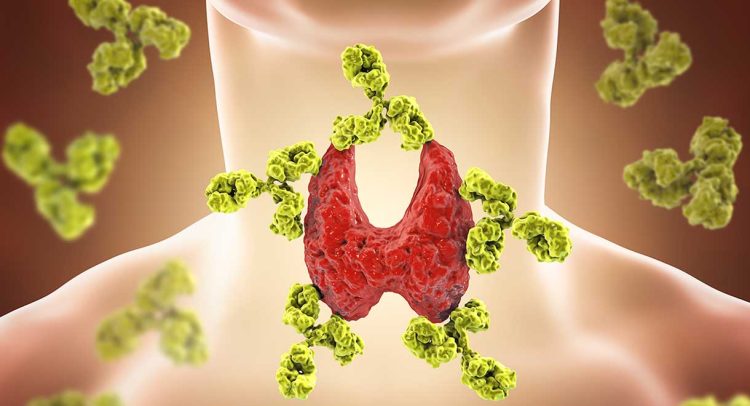
The thyroid gland, situated in the front of the neck, is responsible for producing thyroid hormones which control our metabolism.
Common symptoms of an underactive thyroid gland – known as hypothyroidism are:
Hypothyroidism is commonly the end result of autoimmune disease, usually Hashimoto’s thyroiditis. See my book ‘Healing Autoimmune Disease‘. It can also be due to shrinkage or degeneration in the thyroid gland due to aging or poor nutrition.
A goitre is an enlargement of the thyroid gland. A goitre may be associated with increased, decreased or normal levels of thyroid hormone, depending on the cause. Some causes of goitre include Graves’ disease, Hashimoto’s disease, viral infection, iodine deficiency, pregnancy, puberty and tumors within the thyroid gland. Nodular changes producing multiple cysts in the thyroid gland is a common cause of goitre. Goitres may sometimes reach very large sizes and compress the trachea (wind pipe) or esophagus causing difficulty breathing or swallowing.
For patients suffering hypothyroidism, replacement therapy with thyroid hormone tablets is given for life. Some doctors believe in the concept of resistance to thyroid hormone, which means that your body cells become unresponsive to normal amounts of thyroid hormone. People with thyroid resistance complain of tiredness and excessive weight gain, and yet their blood tests for the levels of thyroid hormone are normal, and in rare cases may be even greater than normal. In such cases, supplemental doses of thyroid hormone have been tried, but this is not without danger, as too much thyroid hormone can strain the heart and increase the risk of osteoporosis. Patients receiving thyroid hormone tablets need to be carefully monitored by their doctor to keep their blood levels within the normal range. In those who are obese because of thyroid resistance, tests to measure levels of reverse T3 should be done. There are two types of thyroid hormone – Thyroxine or T4 and Triiodothyronine or T3. In the body (especially in the liver), T4 is converted to T3. T3 is the more active and potent form of thyroid hormone. If you have an underactive thyroid gland and do not feel well, or are unable to lose weight by taking thyroxine (T4) tablets alone, you could ask your doctor about the possibility of supplementing with triiodothyronine (T3) tablets. Logically, T3 tablets are likely to be more effective in those with a poor response to T4 tablets, because T3 has a more rapid and powerful effect on your metabolism. Triiodothyronine tablets must be given two or three times daily. Your doctor can tailor-make your dosage for you to keep you feeling and looking good and to maintain your blood tests within the normal range.
If there is an overproduction of thyroid hormone (hyperthyroidism), the metabolism speeds up, giving rise to symptoms such as a rapid heart beat, increased appetite, weight loss, diarrhea, intolerance of heat, irritability, tremor, insomnia, malaise and muscle weakness. This is called hyperthyroidism or thyrotoxicosis. The most common cause of thyrotoxicosis is Graves’ disease, which is an autoimmune condition often associated with protruding eyeballs (exophthalmos). Graves’ disease accounts for 85% of all hyperthyroidism.
Thyroid problems are very common, especially in women around the time of the menopause. The most common type of thyroid problem is underactivity of the gland (hypothyroidism). In this disorder, the thyroid gland is not able to manufacture sufficient amounts of thyroid hormone. Thyroid hormone controls the metabolic rate of the body, speeding up the rate at which the cells convert food energy into physical energy.
The thyroid gland produces the hormone called thyroxine, which is also known as T4. Most of the thyroxine (T4) is converted in the body into a more active form of thyroid hormone, which is known as Triiodothyronine or T3.
T3 has approximately 10 times the ability to stimulate the thyroid receptors on the cells. Both T4 and T3 stimulate the energy factories inside the cells to burn food calories at a faster rate. This is why those with an over-active thyroid gland lose weight, even though they are eating much more than normal. See my book called “Your Thyroid Problems Solved”.
Toxins from the environment may alter the thyroid function. Eduardo Gaitan from Univ Mississipi found that drinking water contaminated with petrochemicals results in blocked activity of thyroid hormones (Ref Jounal of Clinical Endocrinology & Metabolism 1983 Vol. 56). Polychlorinated biphenyls (PCBs) can alter thyroxine levels and result in symptoms of thyroid disorders (Science, vol.267). It is now understood that the environment, diet and nutrition influence thyroid function in a number of ways and may relate to thyroid disorders of non specific origin (Annual Review of Nutrition -1995 Vol 15).
Thyrotoxic patients should avoid stimulants like caffeine, coffee, tea, amphetamines and nicotine. Hypothyroid patients should avoid toothpaste containing fluoride, and drink purified water free of fluoride and chlorine.
The function of the thyroid gland can be accurately checked by measuring the levels of thyroid hormone in the blood. A goitre may be investigated by means of a nuclear or ultrasound scan. Your doctor can arrange this. A lump in the thyroid gland may require a fine needle biopsy of the gland.
Thyroid function tests are used to diagnose an underactive thyroid (hypothyroidism) and an overactive thyroid (hyperthyroidism) and monitor the response to thyroid therapy. These tests include the thyroid stimulating hormone test (TSH), the thyroxine test (free T4), the triiodothyronine test (free T3). The blood tests for thyroid gland function should ideally measure the following three hormones –
| Hormone | Normal Range |
| Thyroid Stimulating Hormone (TSH) | 0.5 to 4.0 mU/L |
| Free T4 | 9.0 to 24.0 pmol/L or 4-11 ug/dl |
| Free T3 | 2.2 to 5.4 pmol/L or 110-230 |
Not all laboratories measure or record thyroid hormone levels the same way. Each laboratory will provide a range of values that are considered normal for each test.
If the T4 and/or T3 levels are found to be below the normal ranges, and the TSH (Thyroid Stimulating Hormone) is found to be above the normal range, we can say that the thyroid gland is under active. Most doctors consider the thyroid stimulating hormone (TSH) test to be the most accurate measure of thyroid activity. By measuring the level of TSH, doctors can determine even small problems in thyroid activity. Because this test is VERY sensitive, abnormalities in thyroid function may be determined before a patient complains of any symptoms. TSH “tells” the thyroid gland to secrete the hormones thyroxine (T4) and triiodothyronine (T3). The triiodothyronine (T3) test measures the amount of this hormone in the blood. T3 is normally present in very small amounts, but has a huge impact on metabolism. It is the more active component of the thyroid hormones.
Abnormal thyroid function results may be due to:
Thyroid cancer usually arises out of a lump or nodule in the thyroid gland. The vast majority of thyroid nodules are not cancerous, but a small percentage are. There are a few different types of thyroid cancer; luckily the majority are readily curable.
Thyroid cancer affects approximately 15,000 people in the USA each year. Women are two to three times more likely to develop thyroid cancer than men. Unfortunately, the incidence of thyroid cancer is rising.
Thyroid cancer often goes undetected because it may produce no symptoms at all; thyroid hormone levels are usually normal. If the cancer goes undetected for too long, it may spread to other areas of the body. Exposure to radiation is the biggest risk factor for thyroid cancer, along with exposure to some pesticides and also a deficiency of the minerals iodine and/or selenium increases the risk of thyroid cancer.
The sooner you detect any cancer, the better the outcome. You should become familiar with what your thyroid gland looks and feels like; that way you can pick up any changes in its size, or feel lumps at an early stage.

This is a test you can do yourself at home which is advocated by the American Association of Clinical Endocrinologists. It will help you to pick up changes in the appearance or texture of your thyroid gland at an early stage.
To perform this test you will need a glass of water and a hand held mirror.
Recommended juice recipe from by book “Raw Juices can save your Life”:
Ingredients
Method
If autoimmune thyroid disease is diagnosed (such as Hashimoto’s or Grave’s disease) a gluten-free diet is essential. Low dose Naltrexone may be helpful.
The above statements have not been evaluated by the FDA and are not intended to diagnose, treat or cure any disease.


When you submit your email, you agree to join our mailing list and receive helpful updates, special offers, and product news.