


Hot Flashes
- Home
- Hot Flashes

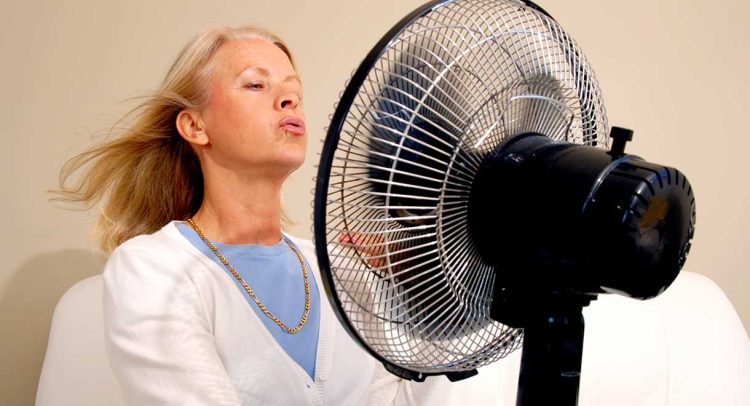
Hot flashes are the single most common symptom associated with menopause. They consist of a sudden sensation of heat which rises usually from the chest up over the neck and face. The face may actually become quite red and sweaty. They last from a few seconds to several minutes and may occur just a few times a year or fifteen to twenty times a day! You may find yourself feeling hot and flustered while those around you are cool, calm and collected, as they complain when you open windows and turn off heaters. The flashes can occur at night as well, but you may only be aware of them after waking drenched with perspiration.
Hot flashes are due to a rapid dilatation of blood vessels on the surface of the skin, which results from the fact that the body’s thermostat, situated in the area of the brain known as the hypothalamus, does not function at all well without the presence of estrogen. The lack of estrogen is of course the hallmark of menopause. Nearly 80 percent of menopausal women are troubled with hot flashes and in 70 percent of this group the flashes will last, on average, for five years. They vary in severity between different women and may be associated with heart palpitations, dizziness and strange crawling or itching sensations under the skin.
A simple treatment at the time of a hot flash is to apply cold water compresses to the face. It is wise to avoid foods and situations that will make you hot such as caffeine, alcohol, cigarette smoking, big meals, emotional exertion, electric blankets and sitting in direct sunlight. Wear cotton clothing if possible, which allows your skin to breathe.
Recommended juice recipe from “Raw Juices Can Save Your Life Book”:
This juice provides nutrients to cool the body and calm the nervous system.
Ingredients
Method
Estrogen replacement therapy is highly effective in the treatment of hot flashes and can be given in the form of a daily troche (lozenge), a gel or cream rubbed into the skin daily, an injection every two to three weeks, or an implant which lasts six to twelve months. In women who still have a uterus, it is combined with the other female sex hormone, progesterone. If you are taking estrogen purely to relieve hot flashes, you may choose to continue it for two to five years and then gradually wean yourself off it. However, estrogen replacement has the added benefit of protecting against heart disease and osteoporosis, and to gain these advantages you can safely continue it for fifteen to twenty years or longer.
Clonidine, an anti-blood pressure drug, is occasionally used as an alternative to treat hot flashes. It works by causing constriction of the blood vessels. It is given in a dose of 25 to 75 micrograms twice daily, but is often only partially effective and may have many nuisance side effects.
Estrogen replacement therapy is the simplest, quickest and most effective way of relieving hot flashes. However, for those women who cannot or choose not to take estrogen for a variety of medical, personal or philosophical reasons the following naturopathic approaches listed, together with the dietary recommendations above, can provide genuine relief.
The above statements have not been evaluated by the FDA and are not intended to diagnose, treat or cure any disease.


When you submit your email, you agree to join our mailing list and receive helpful updates, special offers, and product news.